
Economizers: The Free Cooling That Usually Isn't
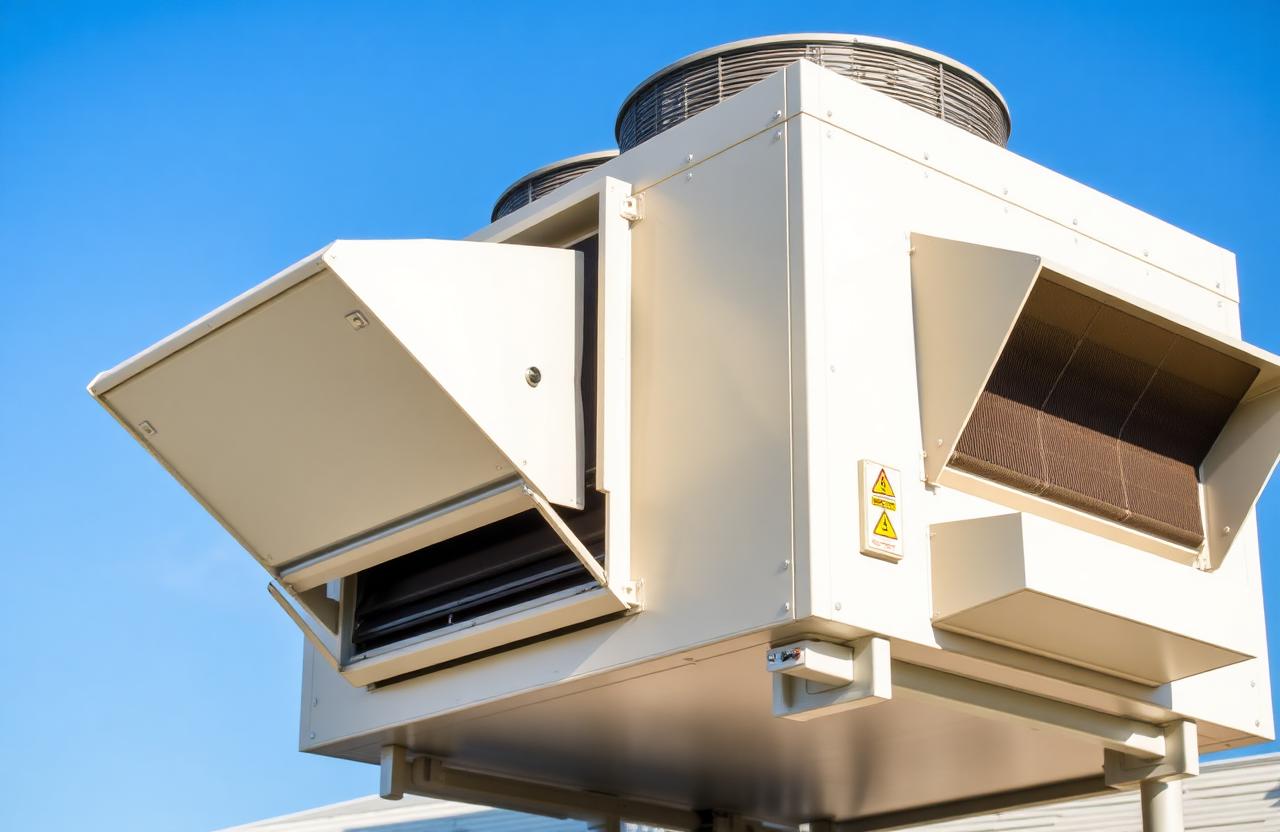
The free cooling that usually isn't
An air-side economizer is one of the highest-payback features on a commercial HVAC system. When outdoor air is cool and dry enough, the unit shuts off mechanical cooling and brings in 100 percent outside air. The energy savings on the right climate and schedule can be 20 to 40 percent of annual cooling energy.
That is the design intent. The field reality, documented in study after study (PG&E, NBI, FEMP), is that 60 to 80 percent of installed economizers are not delivering those savings. They are stuck, miscalibrated, locked out by a bad sensor, or wired so that the dampers never modulate. The energy code took credit for them on day one and they quietly stopped working in year two.
Why economizers fail
The failure modes are remarkably consistent:
- Outdoor air sensor drift. A single dry-bulb or enthalpy sensor sitting on a sun-baked rooftop drifts within a season. The high-limit setpoint trips when it should not, or never trips when it should.
- Linkage and actuator failure. Damper linkages bind, actuators burn out, and the dampers end up stuck at minimum position. The unit looks like it has an economizer; it does not have a working one.
- Wrong high-limit strategy. Specifying differential dry-bulb in a humid climate (or fixed dry-bulb in a dry climate) gives up most of the available savings before the project is even built.
- No mixed-air control. Without a mixed-air temperature sensor and a proper control loop, the economizer either overshoots into freeze protection or undershoots and the mechanical cooling stays on anyway.
- Commissioning that checked the box. A functional performance test that consists of "I forced the damper open and it moved" does not prove the control sequence works under any real condition.
How V3 specifies economizers that work
Pick the right high-limit strategy for the climate. In Texas, ASHRAE 90.1 Table 6.5.1.1.3 gives the allowable high-limit shutoff types by climate zone. We default to differential enthalpy in zones 2A and 3A, fixed enthalpy where differential is not practical, and we document the setpoint on the controls drawings instead of leaving it to the controls contractor.
Specify quality sensors and locate them correctly. Outdoor air sensors get a radiation shield and a north-facing location, not the side of the curb where the sun bakes them. Mixed-air sensors are averaging type, not single-point, located after the dampers and before the heating or cooling coil.
Require a real control sequence in Division 23. Not "provide economizer per manufacturer's standard sequence." A written sequence of operation that includes enable conditions, modulation strategy, minimum outside air maintenance, mixed-air setpoint, freeze protection, and the failure mode when any input sensor fails. The controls contractor implements what we write; if we do not write it, we get the factory default and the factory default is rarely what the project actually needs.
Specify FDD where the code allows or requires it. Fault detection and diagnostics on economizers is a code requirement in most new commercial construction. We specify the FDD points, alarm thresholds, and operator notification path. An economizer that fails silently is the same as no economizer at all.
Commission against the sequence, not against the unit. The commissioning scope tests each enable condition, each lockout, each failure mode. We provide the test scripts as part of the design documents so the CxA prices and executes the actual scope.
Integrated economizers and the lockout trap
Integrated economizers — where the compressor can stage with the economizer providing partial cooling — are required by 90.1 above certain capacities. We specify integrated control explicitly and verify it is enabled at startup. Non-integrated lockouts are still a surprisingly common factory default and they leave easy energy on the table.
What this is worth
On a typical Texas office building, a properly designed and commissioned economizer is worth roughly $0.15 to $0.30 per square foot per year in cooling energy. A broken one is worth zero, and the owner is paying full mechanical cooling all year while the energy model on file says otherwise. The design choices in this post are the difference between the two outcomes.
Have a project to discuss?
V3's licensed PEs deliver coordinated MEP design across Texas and beyond.
Start a conversation