
Storm Drain Sizing: Matching Pipe Capacity to Local Rainfall Rates and Code
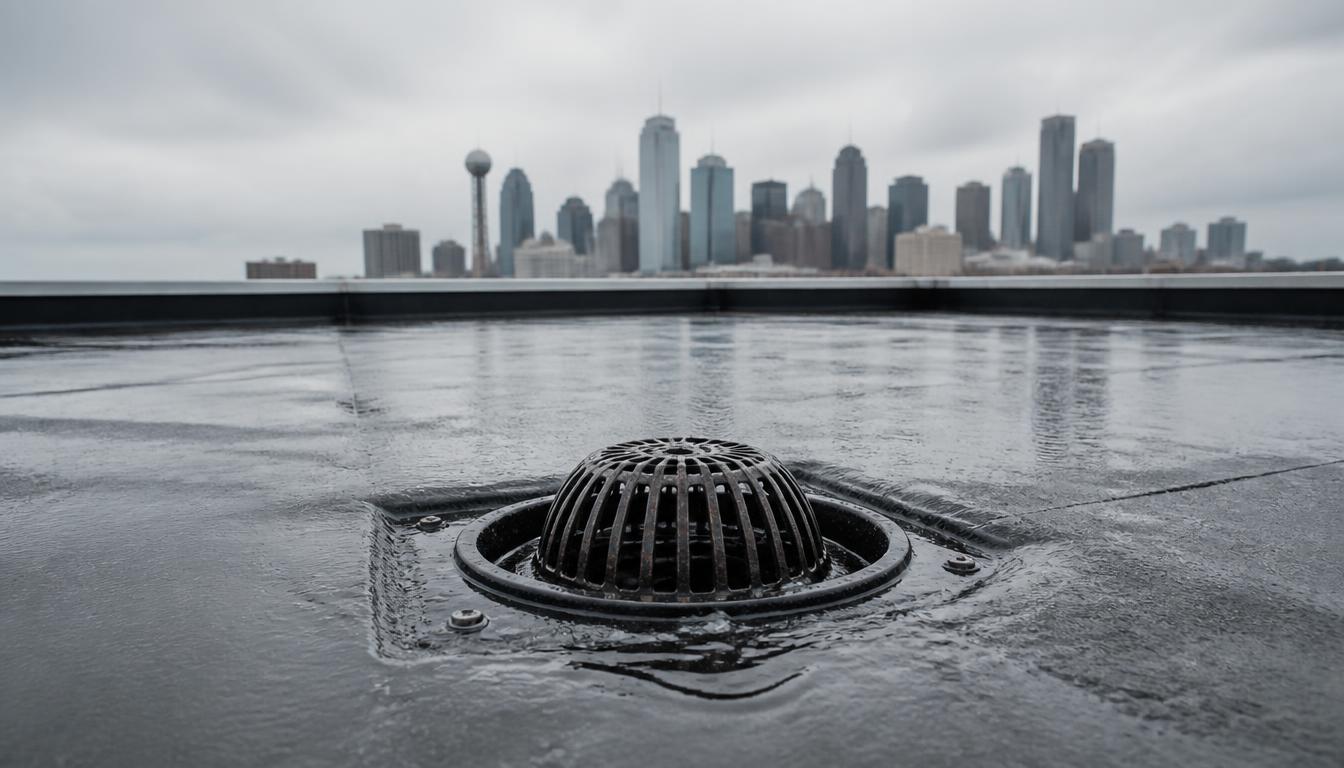
When a summer thunderstorm drops two inches of rain in thirty minutes, the water has to go somewhere. On a commercial site, that “somewhere” is a carefully engineered storm drain system: roof drains, surface inlets, catch basins, and underground pipes that carry runoff away from buildings, parking lots, and pedestrian areas. The size of those pipes is not a guess. It is driven by local rainfall rates, the drainage area, and the industry standards that govern stormwater design.
Why local rainfall matters
A 100-year storm in Dallas is not the same as a 100-year storm in Houston. “100-year” only means a storm with a 1% chance of occurring in any given year; the actual rainfall depth depends on geography and climate. In Central Texas, short, intense downbursts can produce very high rainfall rates over small areas. Along the Gulf Coast, storms may last longer and deliver more total rainfall, even if the peak rate looks similar. That is why engineers turn to local rainfall data rather than national rule-of-thumb charts.
The Rational Method
For most site-scale drainage work, engineers use the Rational Method:
Q = CiA
Where:
- Q = peak runoff rate (cubic feet per second)
- C = runoff coefficient based on surface type (e.g., 0.95 for asphalt, 0.30 for landscaped areas)
- i = rainfall intensity (inches per hour)
- A = drainage area (acres)
The method is intentionally simple, but the inputs make all the difference. Picking the wrong rainfall intensity or runoff coefficient can oversize or undersize a system by a wide margin.
Rainfall Intensity-Duration-Frequency (IDF) curves
The rainfall intensity “i” comes from IDF curves published by NOAA Atlas 14 or local stormwater utilities. These curves tell you how intense rainfall is expected to be for a given storm duration and return frequency. A 10-year, 1-hour storm might have an intensity of 3 in/hr, while a 100-year, 10-minute burst could be 8 in/hr or more. The engineer must match the storm duration to the time it takes for water to flow across the site—the “time of concentration.”
Design storm frequency
Which design storm should you use? That depends on local code and the consequences of flooding:
- 10-year storm is common for minor conveyance and residential streets.
- 25-year or 50-year storm is typical for commercial parking lots and site interiors.
- 100-year storm is often required for buildings, critical facilities, and areas where ponding would cause property damage or safety hazards.
Some jurisdictions also require detention or retention to limit the post-development runoff rate to the pre-development rate, so even if the pipes are sized for the 100-year event, the site may need additional controls to slow the release.
Inlets, catch basins, and grate capacity
Pipe capacity is only half the battle. If the inlets cannot capture the water quickly enough, the site will still flood. The spacing of catch basins, the grate type, and the allowable gutter depth all control how much runoff actually enters the system. A grate that is clogged with debris or located at a low point can become the bottleneck, even if the downstream pipe is oversized. Engineers often apply clogging factors or safety margins to account for real-world conditions.
Pipe capacity and slope
Once runoff is captured, pipe sizing depends on:
- Pipe diameter — larger pipes carry more flow.
- Slope — steeper slopes increase velocity and capacity.
- Roughness — smooth PVC or concrete carries more flow than rough corrugated metal.
- Tailwater conditions — if the outlet is submerged, the pipe may not flow at full capacity.
Manning’s equation is the standard tool for calculating open-channel or gravity pipe flow. Designers also check minimum velocity to avoid sediment buildup and maximum velocity to prevent erosion at outfalls.
Industry standards and codes
Storm drain design is governed by a mix of references:
- ASCE 7 and related civil engineering references for load and hydrology principles
- NOAA Atlas 14 for rainfall frequency data
- Local municipal stormwater criteria for design storm frequency, allowable runoff coefficients, and detention requirements
- EPA stormwater regulations for water quality and post-construction runoff controls
In Texas, cities like Dallas, Houston, Austin, and San Antonio each have their own stormwater criteria manuals, and many require formal stormwater pollution prevention plans (SWPPP) for construction sites over a certain size.
Safety margins and maintenance
Good design includes a margin for uncertainty. Grates may be partially blocked. Silt may reduce pipe capacity over time. Rainfall records are updated as new NOAA data becomes available. A system that barely works on paper will likely fail in the field. That is why engineers often size pipes with a comfortable capacity reserve and design for access and cleanout so the system can be maintained over its service life.
Conclusion
Storm drain sizing is a local problem solved with local data. The same building footprint in Dallas and Houston can produce different peak flows and may require different pipe sizes, inlet spacing, and detention volumes. By combining the Rational Method with NOAA rainfall data, local stormwater codes, and sound engineering judgment, designers can keep commercial sites safe, compliant, and dry when the next storm arrives.
Have a project to discuss?
V3's licensed PEs deliver coordinated MEP design across Texas and beyond.
Start a conversation