
Electrifying Texas Multifamily: What Owners Should Plan for Now
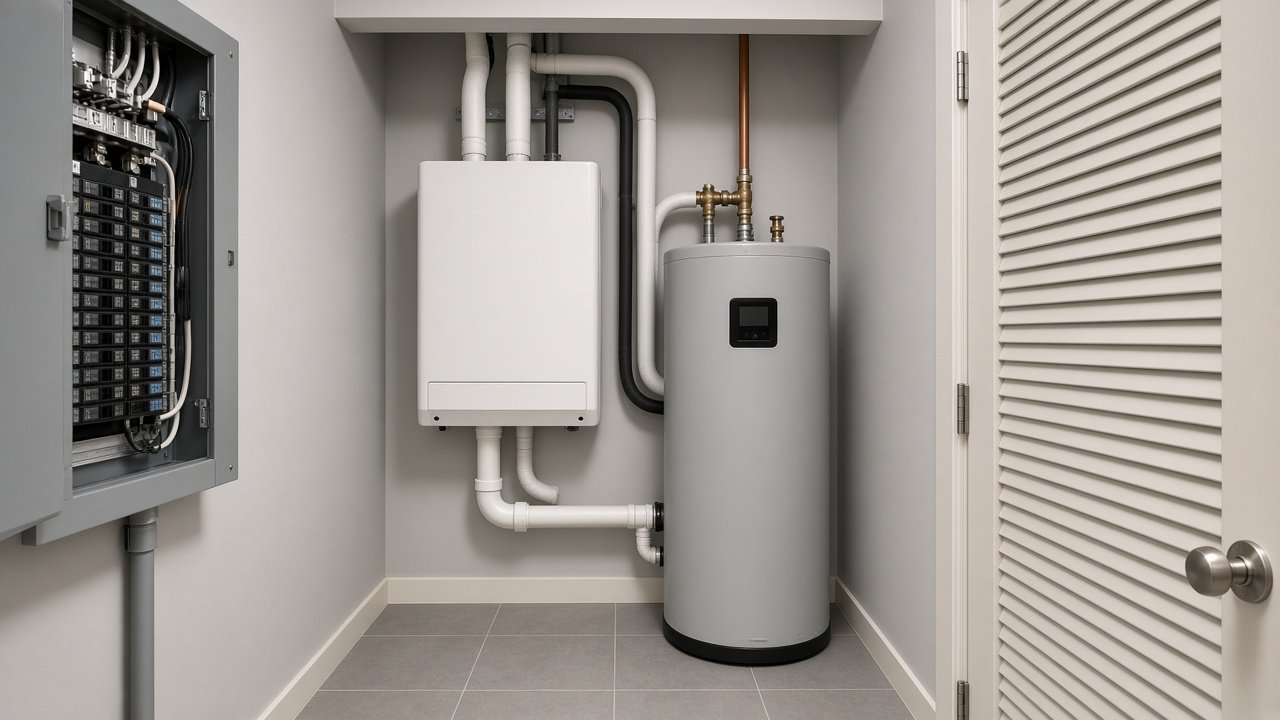
"Should we go all-electric?" comes up on almost every multifamily project now. In Texas, the honest answer starts with what the law does not do: it does not require it. A state law passed in 2021 (HB 17, now Texas Utilities Code §181.903) prohibits cities from restricting utility connections based on the type or source of energy. Gas remains an option across the state.
That doesn't make electrification a non-issue. Local codes, federal equipment standards, refrigerant changes, and the end of several federal incentives are all moving at once. Whether an owner chooses all-electric, mixed fuel, or "electric-ready," the decision is cheapest to make before design development.
What Is Actually Changing
Local codes are adding readiness requirements
As we covered in our post on Texas energy code amendments for multifamily, several cities now require infrastructure for future electric loads:
- Austin adopted electric-ready, EV-readiness, demand-responsive control, and energy storage readiness appendices with its 2024 IECC, effective July 10, 2025. Where gas appliances are installed, the electric-ready provisions call for labeled spare circuits and, in some cases, space for future electric equipment. Water heaters serving multiple R-2 dwelling units are excepted from some of these provisions.
- Houston adopted EV-ready provisions with its 2021 energy code.
- San Antonio requires reserved panel space and capacity for future EV charging, and a separate electrical meter for each R-2 dwelling unit.
None of these mandate all-electric buildings, but all of them add load, panel space, and conduit that should be designed in from the start.
Federal water heater standards tighten in 2029
The Department of Energy's 2024 rule for consumer water heaters takes effect for units manufactured on or after May 6, 2029. For electric storage water heaters above 35 gallons, the new efficiency levels effectively require heat pump technology. Typical in-unit apartment tanks are consumer products under that rule.
A project in design today may be bidding or buying replacements under that rule within a few years. Heat pump water heaters need more space, airflow, and a condensate drain than electric-resistance tanks. If the closet is sized for a resistance tank today, the replacement may not fit later.
Refrigerants have already changed
New residential and light commercial heat pumps and air conditioners have moved to A2L refrigerants such as R-454B and R-32. That affects equipment location, leak detection, and installation details whether the building is all-electric or not. See our article on A2L refrigerants.
Federal incentives have narrowed
Under the 2025 federal tax law known as the One Big Beautiful Bill Act, the 45L new energy efficient home credit is not allowed for homes acquired after June 30, 2026, and the 179D commercial buildings deduction is not allowed for property whose construction begins after June 30, 2026. Owners should not build electrification into a pro forma on the strength of those incentives without confirming eligibility with a tax advisor.
Local utility programs may still be available and change often. As of this writing, CenterPoint Energy has offered new-construction multifamily incentives through its Multifamily Market Transformation / HENC program, and Austin Energy has offered commercial new-construction rebates, including for master-metered or common-area multifamily work, plus a limited Phius-certified affordable multifamily incentive. Oncor's published Multifamily Improvements program and CPS Energy's multifamily incentives are aimed more at existing properties. Confirm current offerings, eligibility, and funding with the serving utility before relying on them in a pro forma.
The Design Decisions That Matter
Space heating
In most Texas multifamily, cooling drives equipment size. Under the federal standards in effect since January 1, 2023, split-system heat pumps and air conditioners in the South share the same 14.3 SEER2 cooling minimum for most residential sizes.
The real question is backup heat. Electric strip heat is simple, but it is often one of the largest loads in an all-electric unit, and it runs hardest during the coldest hours of the year, as Winter Storm Uri reminded Texas in February 2021. Right-sizing auxiliary heat, using heat pumps rated for low-temperature operation where it pays, and controlling staging all reduce the calculated service load.
Water heating
Owners have two basic paths:
- In-unit heat pump water heaters, which keep metering simple, but need closet volume, airflow, and condensate drainage.
- Central heat pump water heating plants, which can reduce in-unit space and allow load shifting with storage, but add recirculation, plant space, and allocation of water-heating costs.
Either way, recirculation controls, storage temperatures, and mixing valves need to be designed together for energy and water safety.
Cooking and laundry
Electric or induction ranges and electric dryers complete an all-electric unit. Ventless heat pump dryers eliminate the dryer exhaust duct and use less energy, but they change laundry closet design and should be evaluated early.
Electrical service
All-electric buildings carry higher calculated loads under NEC Article 220, which determines the service, the transformer, and often the electrical room size. Texas adopted the 2026 NEC statewide effective September 1, 2026. Add EV charging and the service can grow quickly unless the design uses load management, which we covered in EV charging load calcs without the panic.
Coordinate with the serving utility early. Oncor, CenterPoint Energy, CPS Energy, and Austin Energy each have their own service requirements and timelines, and a late change in service size can ripple through the site plan.
Envelope and ventilation
The cheapest kilowatt is the one the building never needs. Better glazing, tighter construction, and well-controlled ventilation reduce heating and cooling loads, which can reduce both equipment size and service size.
What to Plan for Now, Even If You Keep Gas
An "electric-ready" approach keeps options open at modest cost:
- Size closets and mechanical rooms for heat pump equipment, including water heaters.
- Reserve panel spaces and service capacity for future water heating, cooking, and EV charging, consistent with local requirements.
- Route conduit while walls and slabs are open. Adding it later costs far more.
- Reserve roof or plant space if a central water-heating plant might be added later.
- Model the options. Our Energy & Sustainability team compares all-electric, mixed-fuel, and electric-ready designs on first cost, operating cost, and code compliance before the design is locked.
Questions to Answer Before Schematic Design
- Will the owner hold the asset long-term or sell after stabilization?
- Who pays utilities, and how are they metered?
- What does the serving utility require for service size and timing?
- Does the city require EV-ready or electric-ready infrastructure?
- Is gas service already available at the site, and at what cost to extend it?
The takeaway: Texas leaves the fuel choice to owners, but codes, equipment standards, and incentives are shifting underneath that choice. Decide early, design the electrical service and equipment spaces to match, and keep future options open where it costs little to do so.
Talk with V3 about an electrification strategy for your next multifamily project.
This article is general information, not tax, legal, or project-specific engineering advice.
Have a project to discuss?
V3's licensed PEs deliver coordinated MEP design across Texas and beyond.
Start a conversation